Cryptographic cursors
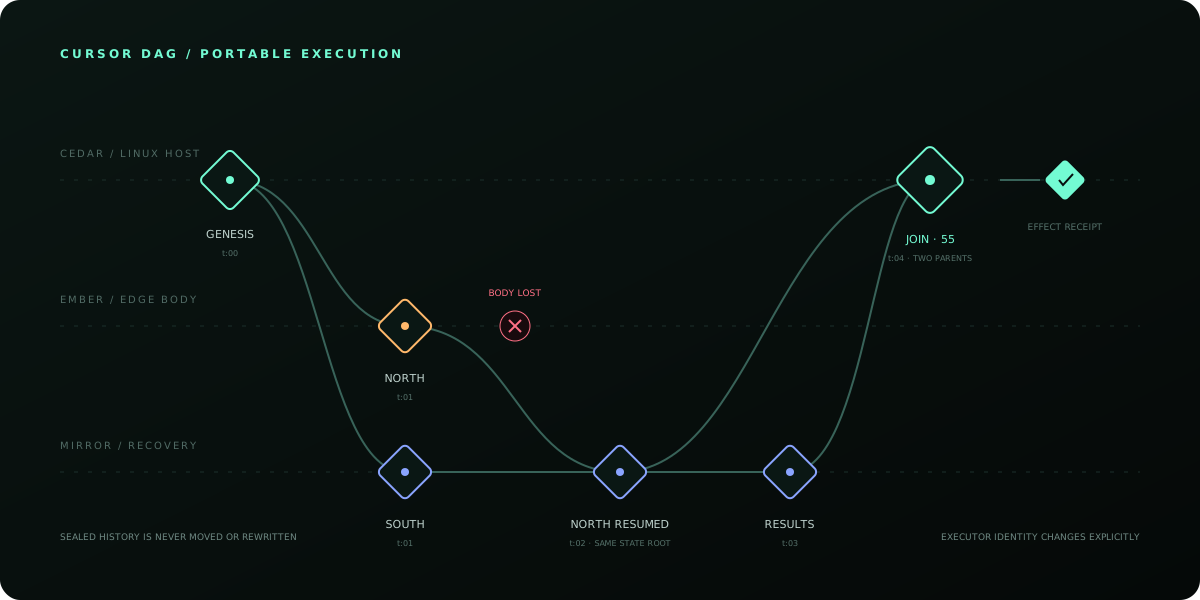
A cryptographic cursor is a sealed point in an execution graph. It is simultaneously:
- a resumable checkpoint reference;
- a causal claim about parent execution;
- a manifest of inputs, outputs, continuation, and authority references;
- a portable unit of scheduling;
- an audit point that can be signed and independently verified.
It is not a memory address, bearer token, packet, process, or serialized heap.
Version 0 record
The executable model seals this payload:
| Field | Meaning |
|---|---|
version |
semantic record version |
parents[] |
sorted unique predecessor cursor IDs |
program |
immutable program/module reference |
continuation |
named resumption point and ABI |
state |
optional immutable state root |
inputs[] |
immutable input references |
outputs[] |
immutable output references already persisted |
grants[] |
capability identifiers, never secret material |
receipts[] |
completed effect or resource receipts |
body |
executor body identity/location-independent reference |
logicalTime |
causal counter greater than every parent |
The author signs the canonical payload. The record identifier commits the payload, author identity, public key, and signature using a domain-separated hash.
Operations
Advance
One or more parents become a child after verified execution. Advancing never mutates a parent.
Pause
Publish a cursor whose state root and continuation are sufficient for a compatible executor to resume. Pausing is a normal advancement, not an out-of-band debugger trick.
Resume
Resolve the state and program, verify grants, select a compatible executor, then create a child cursor. The body may differ from the parent.
Chop
Replace a large state root with independently addressable subgraphs and an assembly description. Chopping changes storage granularity without changing the logical continuation.
Split / fan out
Create multiple children from the same parent, normally paired with an explicit capability split or read-only delegation. Each child has independent failure and scheduling history.
Return
Publish outputs as immutable references. “Returning” across a network does not require pushing all bytes to the parent body; it makes results resolvable under explicit grants.
Join / fan in
Create one child that names every joined parent. Join logic is program-defined: union, reduction, CRDT merge, conflict object, proof aggregation, or explicit human decision.
Rebase
Re-execute a continuation against a different admissible input/state root and produce a new branch. History is not rewritten and the new parentage must be explicit.
Local, network, and world cursors
These are roles, not incompatible record formats:
- a local cursor advances on one body and may use local-only resolution hints;
- a network cursor is advertised or delegated through a fabric;
- a world cursor names a coherent root of a Self's inspectable environment;
- a resource cursor waits on or advances through a device/resource state machine;
- a program cursor selects a continuation in an immutable module graph.
The same cursor can occupy several roles. Policy decides which fields and referenced objects may cross a boundary.
Cursor compatibility
An executor advertises constraints as tuples: architecture, continuation ABI, module formats, page sizes, accelerators, device access, trust level, and budget. Scheduling matches a cursor's requirements against these assertions.
A continuation should prefer portable logical state over blind address-space dumping. Native stack snapshots can be supported as an optimization with strict compatibility labels; WASM, bytecode VMs, and Smalltalk images offer more portable continuation forms.
Invariants worth proving
- canonical equivalent payloads produce identical signing bytes;
- a child logical clock exceeds every parent;
- every referenced output was durably published before the cursor;
- grant chains verify against chosen trust anchors;
- a split conserves declared consumable budgets;
- an effect receipt is stable across retrying bodies;
- cursor publication is idempotent;
- secrets and local resolver hints are absent from durable cursor bytes.
See protocol/curso-0.md for byte-level rules.