Reading the Self-centered circuit cockpit
Current UI: START is the approachable front panel. COCKPIT still opens the organized machine: stable territorial boards, routed traces, selection, focus, and inspection. The copper faceplates are a visual layer, not new transport paths. The service strip and cloud components distinguish observed configuration from paused, unknown, and unverified operations.
Choose a component once to select it, twice to focus it, and use Return to Self to return to the local observer. The guide picture is captured from the current build in an isolated browser; it is not proof that a remote machine is connected.
The cockpit is not a force-directed social graph and it is not perspective 3D. It is a deterministic, Self-centered machine diagram with stable operational territories and a third, semantic axis revealed by zoom and inspection.
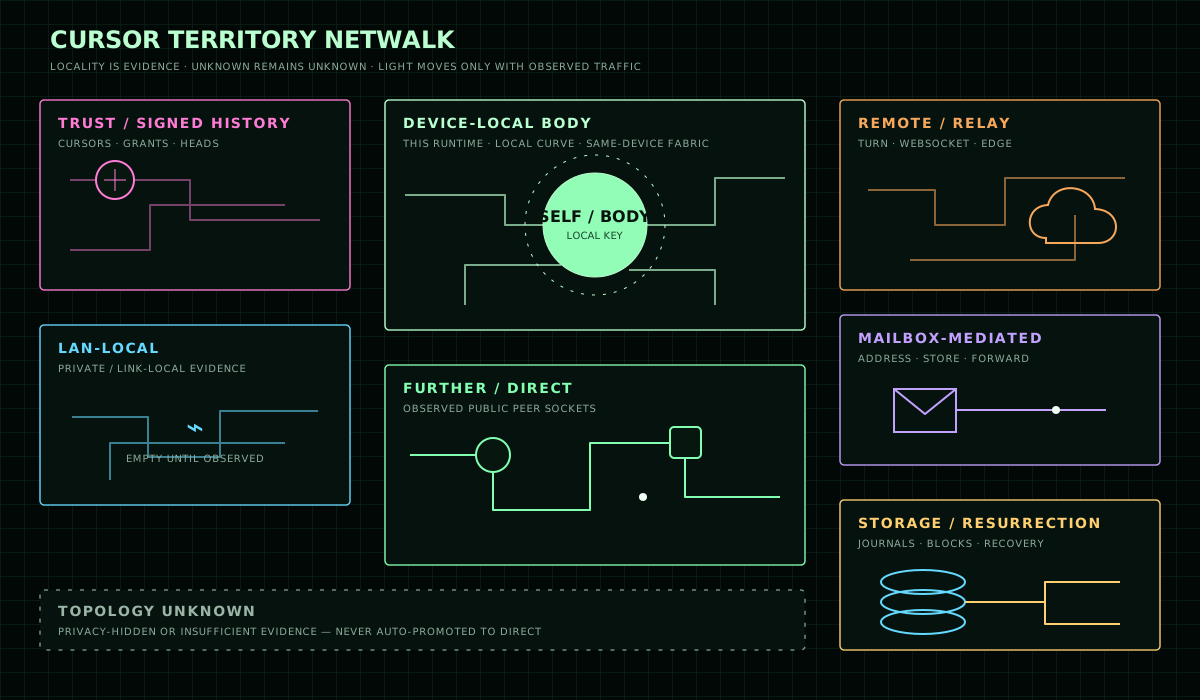
The surface: where is this machinery observed?
| Territory | Question it answers |
|---|---|
| trust / signed history | which signatures, grants, and release heads are being checked? |
| device-local body | what exists inside this runtime and on this device? |
| LAN-local | which path has private or link-local evidence? |
| further / direct | which public socket has actually been observed without a relay? |
| remote / relay | which explicit intermediary carries traffic? |
| mailbox-mediated | where can addressed envelopes wait when bodies are not simultaneous? |
| storage / resurrection | where do journals, encrypted blocks, receipts, and recovery hints live? |
| topology unknown | which carrier exists without enough evidence to place it honestly? |
The third axis: semantic depth
Zooming does not merely make shapes larger. It exposes progressively denser labels, traffic values, circuit detail, and evidence. Selecting a thing opens its Open MCT inspection drawer; the URL records the selection; pinning adds the object to My Items. This makes depth navigable and linkable without requiring a costly 3D renderer.
At every depth, the shape tries to behave like the named machinery:
- a cryptofabric is woven from live circuit threads and boundary pins;
- a mailbox shows an envelope and queued-message lamps;
- storage is drawn as readable journal/database machinery;
- a cryptopointer is a crosshair around a resolvable target, never a bearer token;
- a curve is a pair of changing projections;
- Cloudflare is explicit edge/mailbox/rendezvous machinery and stays dashed until observed.
Modules and interchanges
Every machine is a plug-in module with boundary pins. Its territory describes the strongest supported locality observation. Right-angled circuit traces show designed and observed relationships without allowing a simulation to masquerade as telemetry.
- Solid wire: the cockpit observed or locally instantiated that relationship.
- Dashed wire: designed or configured, but not currently observed.
- Moving photon: a measured positive byte rate or stored local message count.
- Highlighted route: directly touches the selected module.
- Self hub: this browser body fixed at the geometric center of the machine.
- Self PIP: the screen-space return control shown after focus; it does not move or duplicate the topological Self node.
Why the map keeps the radar
The radar sweep is an instrumentation clock, not a claim of radio discovery. It frames a changing operational horizon while the module layout remains stable enough to build spatial memory.
Traffic drill-down
Click Downlink, Uplink, Transport Peers, or Verified Pieces. The exchange devtools table reports:
- observed direction and rate;
- material family;
- carrier and counterparty;
- locality evidence;
- author evidence;
- executing body;
- current store or database role.
Aggregated torrent rates cannot prove which peer authored content. Public torrent metadata therefore remains UNPROVEN / TRANSPORT METADATA. A Caravan head may name a pinned directory signer, but accepted cursor authorship still requires the cursor record signature. Try Memory Cryptopointer, Local Mailbox, Browser Memory, and Cloudflare Mailbox Object.